



Scenic flats - Avenue Q
for Ariel Theatre Company
One of the more challenging productions presented to us during our degree was the creation of scenic flats and backdrops for a production of Avenue Q by Ariel Theatre Company. Not only would the flats have to be fit for purpose on their main stage, but the whole set would have to be made available to rent to outside production houses. Therefore, the set had to be easy to transport, easy to maintain and easy to put togther.
The brief called for two main flats, both with side reveals. One would be nearly three metres wide, with two operating doors and one operating window. The other side would be nearly two metres wide, with one operating door and one usable window. All windows would require styrene glass panels and window sills. We also needed to provide a metal railing and a chan link fence to go between these two flats, as well as some canvas backdrops of a comdey club and a highrise building.

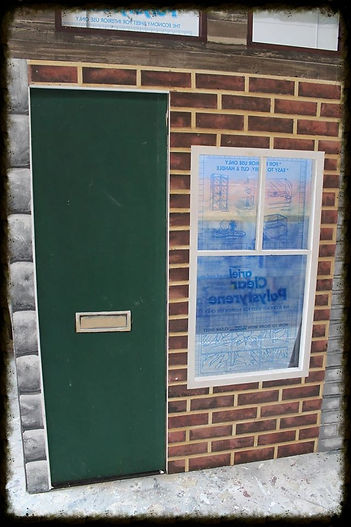
Two the left are two examples of my scenic paintwork. We knew that we would have to incorporate a lot of paint effect into the final sets, considering the side reveals and main flats would be made out of 6mm ply on top of 2x1 timber framing. The paintwork as shown on the left is created using idenden and sand in the paint mixture. Whilst this efect is ecellen t in creating realisitic brickwork, it was sadly unavailable to us as an option. If we wanted the sets to 'flat pack', we would have to have the top and bottom storeys fold together via pin hinges, and the paint effect woud have simply worn itself away. Therefore, we would have to do basic paint effect going forward. This was for the main red brickwork, the stonework, and the woodwork.
We had met with the founders of Ariel theatre company on a couple of occasions to provide them with scale models of our envisaged sets. Once all dimensions were approved, we went ahead with the constuction.The timber framing was all cut from extensive cut lists after I made some basic blueprints in Google Sketch-Up. The timber would be screwed together with 70mm screws, and then plywood triangular bracing was also used on the corners. The plywood fonts were cut in sections via a wall saw, and stuck to the timber framing with a nail gun and wood glue.
I completed the carpentry in approxmately four days with the help of a collegue. After we had completed the flats, we had to make two pieces of french bracing for both flats. That way, the side reveals and the bracing would help kee the flats upright. The bracing was build to stand at three meters tall - about halfway up the top floor. The bracing itself needed to be hinged in the middle, to make sure it was easily storable and transportable.
The finished product. The doors and windows were all operable. The side reveals can be seen pointing toward the front of the stage. The whole set can flat pack easily into the back of a transit van, all with the aid of a few pin hinges.